Research
Mutational Properties of Polyploid Caenorhabditis elegans
Principal Investigator: Dr. Charles Baer
University of Florida Department of Biology
August 2024 - Present
Mutational Properties of Polyploid C. elegans.

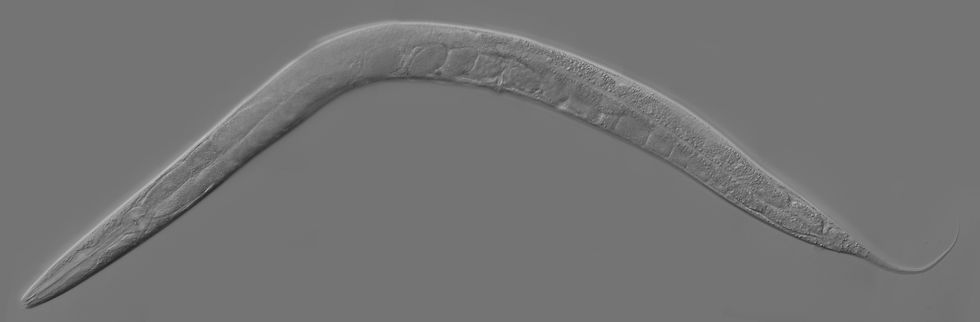
Image of an adult C. elegans from Society for Mucosal Immunology
Overview
August 2025 - present
Through the University Scholars Program, I have begun an investigation into the process of autopolyploidization and allopolyploidization of C. elegans nematodes. My goal is to make a stable autopolyploid line of C. elegans that is genetically distinct from the existing autopolyploid line, N2. I then plan to cross the two polyploid lines to create an allopolyploid, an organism with 2 copies of slightly different genomes. This project would address questions about the early evolution of new polyploid lines because the parental lines will be distinguishable.
Mutational Properties of Polyploid C. elegans.
Roles and Responsibilities
For this project, I am the main investigator, running the project under Dr. Baer's supervision. My responsibilities for this project include
preparing rec-8 RNA-interfering E. coli bacteria clones, identifying and picking worms displaying the polyploid (long) phenotype, using fluorescent microscopy to confirm polyploidy, and then facilitating the hybridization of two different polyploid lines. For this project, I am also responsible for basic nematode husbandry skills which I also complete in my role as a research assistant for Dr. Baer's other projects.

Image I took through a microscope, displaying a single C. elegans worm in the L4 lifestage. The worm is on a field of E. coli on an agar plate. The large darker spots on the bottom half of the image are clumps of bacteria that I disturbed when placing the worm on the plate with the pick.


The Baer Lab
I have worked in the Baer lab since August 2024, and I became the lead lab assistant in January 2025. While working in the lab, I have assisted Dr. Baer with his research projects, including a mutation accumulation study in diploid and polyploid C. elegans, and a project to extract and sequence DNA from other nematode lines, C. briggsae and C. brenneri. Outside of my own project, I still assist Dr. Baer in running the lab and his own projects. My roles and responsibilities as a lab assistant include regularly performing
basic nematode husbandry skills, which include identifying different worm stages and "picking" worms, preparing nematode media by making agar plates, and culturing E. coli stock. I also execute specialized nematode maintenance techniques, such as cryopreservation and thawing from freezing, and decontamination using a bleaching method. My role also means I am responsible for maintaining stocks of chemicals and solutions, properly disposing of biohazardous waste, and ensuring the lab space is safe, clean, and sterile when necessary.